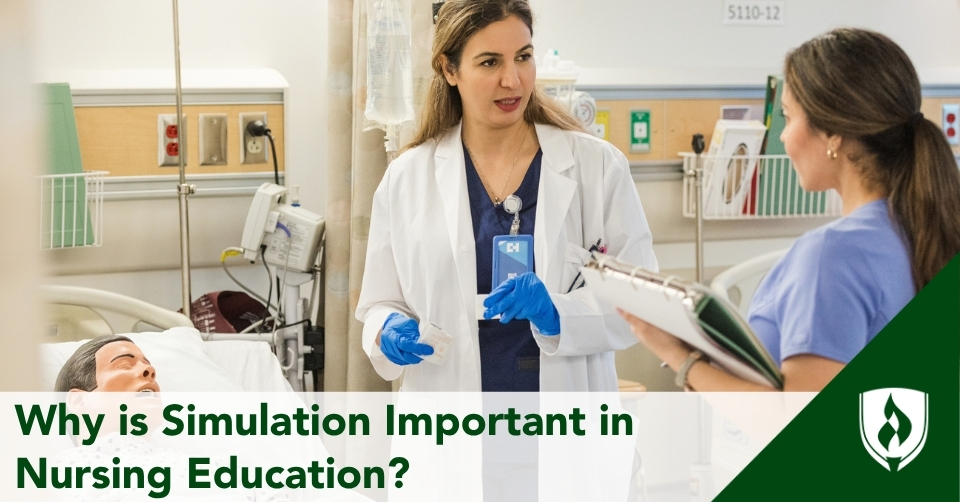
Simulation is important in nursing education because it gives nursing students a safe and controlled environment to practice clinical skills before caring for real patients. Through simulation, students can apply theoretical knowledge, develop clinical judgment and gain confidence in the decisions they will need to make in clinical settings.
Simulation in nursing education does not replace clinical rotations or real patient care. Instead, it helps prepare future nurses for those experiences by allowing them to practice assessment, communication and decision making in realistic but controlled situations.
By working through patient care scenarios before entering a clinical environment, students can make mistakes, ask questions and learn from feedback without putting patient safety at risk. This helps connect classroom learning to hands-on nursing practice.
What is simulation in nursing education?
Simulation in nursing education is an innovative teaching method that recreates patient care situations for students. These simulation experiences allow nursing students to practice nursing skills, respond to patient needs and work through clinical decisions in a realistic learning environment.
Clinical simulation can take many forms. Students may work with mannequins, task trainers, virtual simulations or simulated patients who are trained to act out specific medical situations.
Some simulations focus on one skill, such as starting an IV, taking vital signs or practicing an assessment. Others involve a full simulation scenario where students must monitor changing symptoms, communicate with other healthcare professionals and decide what to do next.
Types of simulation used in nursing education
Nursing programs may use several types of simulation depending on the program format, learning goals and skills being taught. Some simulation experiences happen in nursing simulation labs, where students can practice clinical skills with equipment, mannequins, task trainers and realistic patient care spaces. Others may take place through virtual simulations or online learning environments.
Mannequin-based simulation
Mannequin-based simulators allow nursing students to practice patient care in a realistic but controlled environment. Some mannequins can be programmed by instructors to respond based on the student’s actions, giving students a chance to assess changing patient conditions and decide what to do next.
High fidelity mannequins may be able to simulate vital signs, bodily functions or changes in a patient’s condition. Other mannequin-based simulators may be used for focused skills, such as CPR practice. For example, some CPR mannequins can help students identify whether their chest compressions are deep enough.
Standardized patients
Standardized patients are trained people who act out specific medical cases or patient interactions. They may provide a medical history, describe symptoms, show emotional responses or respond physically during an assessment.
This type of simulation helps students practice communication, assessment and clinical reasoning with a person who can respond like a patient. It also helps students learn how to ask questions, listen carefully and respond to patient concerns.
One example of standardized patient simulation may involve volunteers or trained actors helping in a nursing school setting.
I have had the opportunity to let my children serve as “trained actors” for a local nursing program. My older children were given scripts and acted out patient scenarios, while my younger children were seen by the students with me present as their mom. Nurse practitioner programs are often looking for volunteers for these types of roles.
Virtual simulations and virtual reality
Virtual simulations use simulation technology to help students work through patient care scenarios in a digital setting. These tools may be especially helpful for online or hybrid nursing programs because they allow students to practice decision making even when they are not physically in a simulation lab.
Virtual reality can also create simulated environments where students interact with various scenarios and respond to patient needs. Some CPR and ACLS programs now use virtual simulations for the classroom portion of training before students complete the hands-on portion in person.
Task trainers
Task trainers help students practice specific procedures or nursing skills before applying them in a broader clinical environment. These may include models, equipment or trained people who help students learn a particular skill.
Task trainers may be used for procedures such as IV insertion, cervical cancer screenings, pap smears, HPV testing or prostate exams. When I was in Family Nurse Practitioner school, we worked with a female trainer who guided us through a pap smear exam and a male trainer who guided us through a prostate exam on himself. That experience was helpful because the trainers could explain what we should be looking for and how to perform the exam correctly.
By focusing on one skill at a time, task trainers can help students build proficiency before they use those skills in more complex clinical simulation experiences.
How simulation helps nursing students build clinical skills
Simulation gives nursing students a safe environment to practice clinical skills before working with real patients. In a controlled environment, students can build nursing skills, ask questions and receive feedback while they are still learning.
These simulation experiences may help students practice skills such as:
- Taking vital signs
- Completing patient assessments
- Communicating with patients
- Responding to changes in a patient’s condition
- Practicing technical skills
- Making care decisions
- Working with other members of the healthcare team
One of the benefits of simulation is that students can make mistakes without putting patient safety at risk. Mistakes are an important part of learning, especially when students are practicing new or complex skills.
In a safe and controlled environment, instructors can pause the simulation, explain what happened and help students identify areas for improvement. This allows nursing students to gain experience, build proficiency and gain confidence before they enter clinical settings.
How simulation supports critical thinking and confidence
Simulation helps nursing students connect classroom learning to patient care. Students may understand nursing concepts in a textbook, but a simulation scenario asks them to apply that knowledge in a realistic situation.
During clinical simulation, students may need to assess a patient’s condition, review vital signs, notice changes, communicate with others and decide what action to take next. This helps them practice critical thinking, clinical judgment and decision making before caring for real patients.
Simulation can also help students gain confidence before they enter clinical rotations or other clinical settings. Because the experience happens in a safe environment, students can make mistakes, receive feedback and identify areas for improvement without putting patients at risk.
These experiences can help future nurses build the necessary skills they will need in healthcare settings, including patient assessment, communication, teamwork and safe decision making.
Benefits of simulation for nursing faculty
Simulation also offers benefits for nursing faculty and instructors. In nursing simulation labs, faculty can observe how students use clinical skills, communicate with patients and respond to a simulation scenario before they enter clinical settings.
This gives instructors a chance to identify areas where students may need more practice, support or simulation training. Faculty can also provide immediate feedback while the experience is still fresh.
Debriefing is an important part of this process. After a simulation, instructors can help students reflect on what went well, what they missed and what they could do differently next time. This helps faculty teach skills in a way that supports student development and prepares students for real patient care.
The future of simulation in nursing education
Simulation technology will likely continue to grow as artificial intelligence, virtual reality and virtual simulations become more advanced. These tools may give nursing students more access to realistic patient care scenarios and help nursing programs create new ways to teach clinical skills.
Future simulation experiences may also become more responsive. For example, mannequins and virtual patients may be able to show more realistic changes in vital signs, symptoms and bodily functions. This can help students practice clinical judgment in situations that feel closer to what they may experience in healthcare settings.
Still, the importance of simulation in nursing education is not only about technology. Simulation gives nursing students a safe place to connect knowledge to practice, build confidence, develop critical thinking skills and prepare for patient care. As nursing education continues to change, simulation can play a vital role in preparing future nurses to provide safe, thoughtful and skilled care.
Interested in learning more about how technology can support nursing? Read AI in Nursing: 5 Things it Can (And Can’t) Do for more!