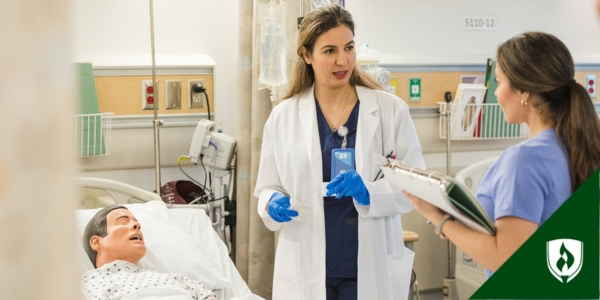
The path to a clinical nurse educator role starts well before any educator-specific training. First, you typically need to become a licensed registered nurse (RN). From there, potential steps toward this type of role may include gaining clinical experience, taking on informal teaching opportunities, and pursuing graduate-level education focused on areas such as nursing education, technology, or simulation.
A Potential Path Toward a Clinical Nurse Educator
Step 1: Become a licensed registered nurse. Before anything else, this path starts with becoming a registered nurse. According to the American Nurses Association®, a Bachelor of Science in Nursing (BSN) is often the minimum educational requirement for a nurse educator role, so one potential route toward this type of role is earning a BSN and maintaining an active RN license.1
Step 2: Gain clinical experience and informal teaching opportunities. Nurse educators build toward the role gradually, often starting by volunteering to lead education sessions for coworkers or serving as a preceptor for new staff. Teaching CPR or first aid courses to colleagues or the public is another common way to build an educational foundation before pursuing more formal training.1
Step 3: Understand the difference between clinical and academic settings. It helps to know that nurse educators work in more than one kind of environment. In clinical settings, the focus tends to be on enhancing patient care through education, while in academic settings, nurse educators are more focused on preparing the next generation of nurses.1
Step 4: Pursue graduate-level education. Some nurse educator positions may require or prefer graduate-level education, depending on the employer and role.1
At Rasmussen University, the online Master of Science in Nursing offers two specializations that include coursework related to clinical nursing education:2
- The Nursing Education specialization focuses on preparing nurses to educate others in clinical and academic settings.
- The Healthcare Technology, Simulation, and Informatics specialization is built around informatics, simulation, and emerging health technology.
Step 5: Explore skills relevant to each specialization. If your interest is in hands-on, day-to-day clinical teaching, the Nursing Education specialization covers curriculum design, program evaluation, and teaching strategies for both classroom and clinical settings.2
If your interest leans more toward the technology side, the Healthcare Technology, Simulation, and Informatics specialization covers current health technology, simulation-based education, and the foundations of nursing informatics.2
What Does a Clinical Nurse Educator Do?
Clinical nurse educator responsibilities vary by role and setting. According to the American Nurses Association, that may include orienting new staff, developing and implementing continuing education programs, and contributing to policy or research initiatives within a healthcare organization.1
Some clinical nurse educators focus mainly on hands-on teaching and precepting, while others lean more into simulation and technology-based training, depending on the setting and their particular focus.1
What Skills Do Clinical Nurse Educators Need?
- Clinical expertise, since the role is grounded in real nursing practice and patient care
- Communication and teaching skills, for translating clinical knowledge into something others can learn and apply
- Curriculum design and evaluation skills, for those focused on the hands-on teaching side of the role2
- Comfort with emerging technology, for those focused on the simulation and informatics side of the role2
- Adaptability, since healthcare practices and technologies continue to evolve1
Typical Career Paths
Rasmussen University lists the following potential career paths for these specializations. Some of the most common typical career paths may include:
- Director of Nursing
- Director of Education
- Clinical Nursing Informatics Officer
- Chief Nursing Officer
These roles may require additional education, certifications, or experience depending on the employer and specific position. View the Rasmussen program page for a complete list of typical career paths.2
Exploring the MSN Program at Rasmussen University
If you're interested in exploring a path to becoming a clinical nurse educator, learn more about the online Master of Science in Nursing program at Rasmussen University.2
Earning a degree does not guarantee employment or specific job outcomes. Employment conditions in your area may vary. Role titles, duties, and licensure or certification requirements vary by state and employer.
American Nurses Association® is a registered trademark of American Nurses Association.
1American Nurses Association, Shaping Future Healthcare: The Path to Becoming a Nurse Educator, at https://www.nursingworld.org/content-hub/resources/nursing-resources/becoming-a-nurse-educator/ (accessed Sept. 1, 2026).
2Rasmussen University, Master of Science in Nursing, at https://www.rasmussen.edu/degrees/nursing/msn/ (accessed Sept. 1, 2026).