Exploring Medical Assistant Certification Requirements
11/24/2026
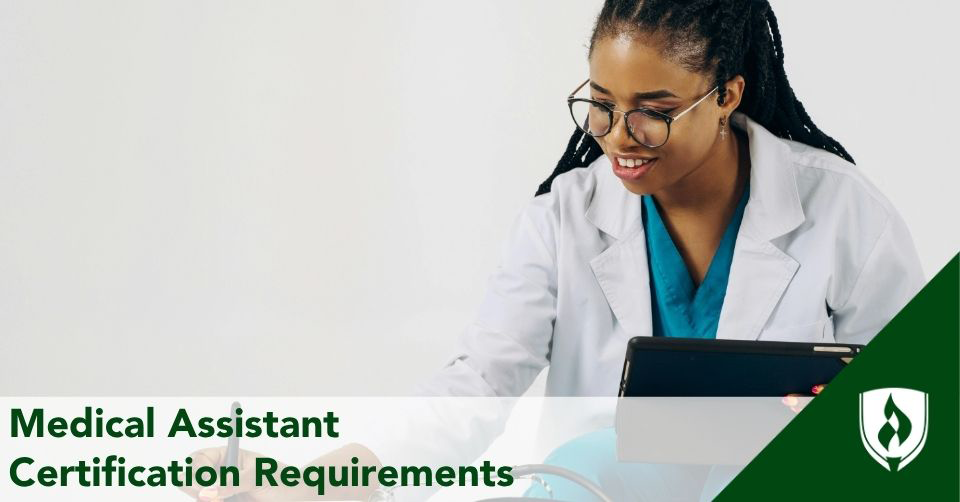
Medical assistant certification requirements depend largely on where you plan to work. In the U.S., check the requirements in the state where you plan to work and ask prospective employers which certifications, if any, they prefer or require.1
Explore five steps to understanding medical assistant certification requirements, from state regulations and employer preferences to education and certification options.
Step 1: Check What Your State Requires
Start by reviewing medical assistant requirements in the state where you plan to work. Some states may require medical assistants to graduate from an accredited program, be licensed or hold a national certification, or meet other prerequisites before they can practice in a specific location or position.1
The most reliable way to find out what applies to you is to contact your state licensing agency directly.1 It’s worth doing this early, because the answers may shape which education options and certification paths make the most sense for you.
Step 2: Research Medical Assistant Certification Requirements from Employers
Even in states without a specified national certification requirement, employers may set their own expectations. Other professional-level certifications are something employers may prefer or require, such as Basic Life Support (BLS) certification.1
One practical way to get a feel for this is to browse job postings for medical assistant roles in your area and note which credentials come up most often. Employers in different settings, such as physician offices, hospitals, and outpatient clinics, may not all ask for the same things.
Step 3: Understand Medical Assistant Education Requirements
Certification and education often go hand in hand. Medical assistants typically complete a postsecondary program. These programs generally include coursework such as medical terminology, anatomy and physiology, and pharmacology, along with supervised experience like a practicum or internship.1
Education requirements can vary, and some people enter the field with a high school diploma and learn through on-the-job training instead.1 Still, employers often prefer candidates with more education, so it can help to compare what different programs include before you decide.1
Step 4: Compare Medical Assistant Certification Options
Medical assistant certification is available from several organizations, each with its own eligibility requirements.1 One option is the Certified Medical Assistant® credential, CMA (AAMA)®, from the American Association of Medical Assistants®. To be eligible for the exam, applicants must meet one of these requirements:2
- Be a student or graduate of a medical assisting program accredited by the Commission on Accreditation of Allied Health Education Programs (CAAHEP) or the Accrediting Bureau of Health Education Schools (ABHES®)
- Be previously certified as a CMA (AAMA)®
- Be a qualifying medical assisting educator
- Meet the requirements of an alternative pathway
You can review the full eligibility details on the AAMA eligibility page.2
Step 5: Choose a Medical Assisting Program That Supports Your Certification Goals
Once you know what your state and local employers expect, you can look for an education program that lines up with it. As you compare programs, it may help to look at:
- Whether the program’s accreditation fits the certification options you’re considering
- Whether the curriculum covers both clinical and administrative skills1
- Whether it includes supervised experience, such as a practicum or internship1
- How long the program takes, since many take about one to two years1
Explore the Medical Assisting Diploma at Rasmussen University part of American Public University System
Rasmussen University offers a Medical Assisting Diploma, and graduates of its programmatically accredited programs can sit for the CMA (AAMA)® or Registered Medical Assistant (RMA) exam.3
The program lists medical assistant and medical office administrative assistant among its typical career paths. If you're exploring certification requirements as part of choosing a program, learn more about the Medical Assisting Diploma at Rasmussen University.3
Earning a diploma does not guarantee employment or specific job outcomes. Employment conditions in your area may vary.
Certified Medical Assistant® is a registered trademark of the American Association of Medical Assistants.
CMA (AAMA)® is a registered trademark of the American Association of Medical Assistants.
American Association of Medical Assistants®is a registered trademark of American Association of Medical Assistants.
ABHES® is a registered trademark of the Accrediting Bureau of Health Education Schools.
1Bureau of Labor Statistics, U.S. Department of Labor, Occupational Outlook Handbook, Medical Assistants, at https://www.bls.gov/ooh/healthcare/medical-assistants.htm#tab-4 (accessed Oct. 7, 2026). Employment conditions in your area may vary.
2American Association of Medical Assistants, Eligibility, at https://www.aama-ntl.org/certification/eligibility (accessed Oct. 7, 2026).
3Rasmussen University, Medical Assisting Diploma, https://www.rasmussen.edu/degrees/health-sciences/medical-assisting/ (accessed Oct. 7, 2026).