What Is Medical Assisting?
11/24/2026
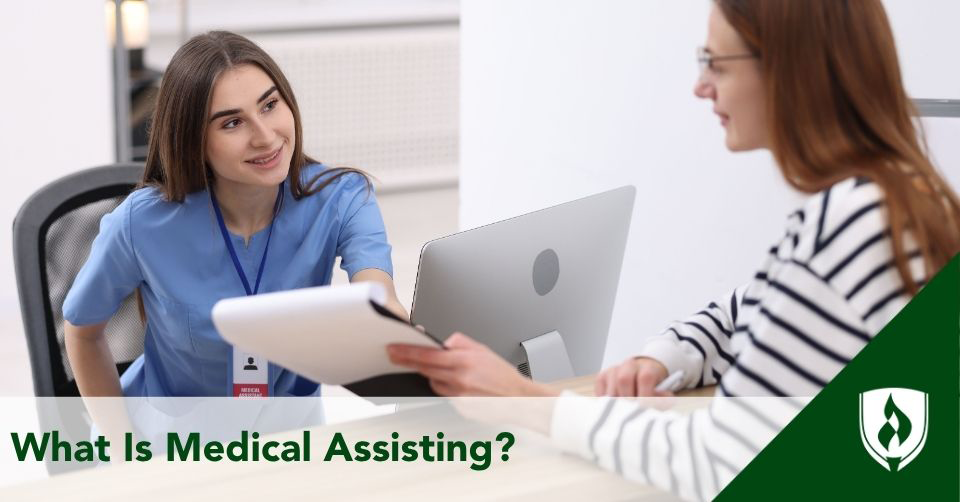
Medical assisting is a healthcare career built around supporting patients and the providers who care for them, through a combination of clinical and administrative tasks.1
Medical assistants may take a patient's vital signs in one moment and schedule a follow-up appointment in the next. Their specific duties vary by location, specialty, and employer.1 Here's a closer look at what medical assisting involves, where this work takes place, and the education and qualities associated with it.
What Does a Medical Assistant Do?
Medical assisting can be described as a bridge between a medical practice's front office and its exam rooms. On the patient side, medical assistants typically help gather the information providers need. On the office side, they help keep the practice organized.1
Typical responsibilities may include:1
- Interviewing patients and recording their medical history
- Measuring vital signs, such as blood pressure and weight
- Helping physicians with patient examinations
- Giving injections or medications as directed by physicians and as permitted by state law
- Collecting and preparing blood and other specimens for laboratory tests
- Entering patient information, such as vital signs and test results, into medical records
- Scheduling patient appointments
- Keeping track of medical and office supplies
Some medical assistants focus mostly on clinical tasks, others on administrative ones, and some do both.1
The administrative side can include:1
- Helping patients understand and receive insurance coverage
- Completing forms
- Coding information
- Contacting insurance companies about billing.
Depending on the state, clinical tasks may also include:1
- Basic laboratory tests
- Sterilizing instruments
- Disposing of contaminated supplies
Some medical assistants also specialize based on the type of practice they support. For example, assistants who work with eye care providers may show patients how to insert, remove, and care for contact lenses.1 Medical assistants are also expected to follow confidentiality standards when handling patient information.1
It's worth noting that medical assisting is a different occupation from physician assisting. Both work under the direction of physicians, but physician assistants practice medicine and can prescribe medication under a physician's supervision, while medical assistants do not.1
Where Medical Assistants Work
Medical assistants are found across many healthcare settings. Most often, they work in:2
- Physicians' offices
- Hospitals
- Outpatient care centers
- Offices of other health practitioners
The pace and physical demands of the job can vary from one setting to the next. Some medical assistants spend much of their time on their feet, moving between patients, while others spend more of the day at a computer handling administrative tasks.2
Because the role blends hands-on and office work, the mix of tasks often depends on how a particular practice is organized.
What Education and Skills Do Medical Assistants Need?
Education requirements can vary, but medical assistants typically complete a postsecondary program. These programs are offered through community colleges, vocational and technical schools, and universities.3
Coursework often includes medical terminology, anatomy and physiology, and pharmacology, along with supervised experience such as a practicum or internship.3 Some people enter the field with a high school diploma and learn their duties through on-the-job training, although employers often prefer candidates with more education.3
Requirements can also differ by state. Some states require medical assistants to graduate from an accredited program, be licensed or certified, or meet other prerequisites to practice. Although most states do not require certification, employers may prefer or require it.3 Anyone curious about the field may want to check with their state licensing agency to see what applies where they live.3
Certain personal qualities also tend to matter in this work:3
- Analytical skills, to understand medical charts and diagnoses
- Communication skills, to explain information clearly to patients
- Compassion, to support patients who may be sick, injured, or in distress
- Attention to detail, since providers, patients, and insurers rely on accurate records
- Interpersonal skills, to work well with both patients and other healthcare professionals
Explore the Medical Assisting Diploma at Rasmussen University part of American Public University System
Rasmussen University offers a Medical Assisting Diploma that combines online coursework with on-campus labs and an off-campus externship. The program lists medical assistant and medical office administrative assistant among its common career paths. If you're interested in building skills relevant to medical assisting, explore the Medical Assisting Diploma at Rasmussen University. Program availability varies by state.4
Earning a diploma does not guarantee employment or specific job outcomes. Employment conditions in your area may vary.
1Bureau of Labor Statistics, U.S. Department of Labor, Occupational Outlook Handbook, Medical Assistants, at https://www.bls.gov/ooh/healthcare/medical-assistants.htm#tab-2 (accessed Oct. 6, 2026). Employment conditions in your area may vary.
2Bureau of Labor Statistics, U.S. Department of Labor, Occupational Outlook Handbook, Medical Assistants, at https://www.bls.gov/ooh/healthcare/medical-assistants.htm#tab-3 (accessed Oct. 6, 2026). Employment conditions in your area may vary.
3Bureau of Labor Statistics, U.S. Department of Labor, Occupational Outlook Handbook, Medical Assistants, at https://www.bls.gov/ooh/healthcare/medical-assistants.htm#tab-4 (accessed Oct. 6, 2026). Employment conditions in your area may vary.
4Rasmussen University, Medical Assisting Diploma, https://www.rasmussen.edu/degrees/health-sciences/medical-assisting/ (accessed Oct. 6, 2026).


