How to Become a Crime Scene Investigator (Or Its Real-Life Equivalent)
By Kate Zuritsky on 03/12/2026
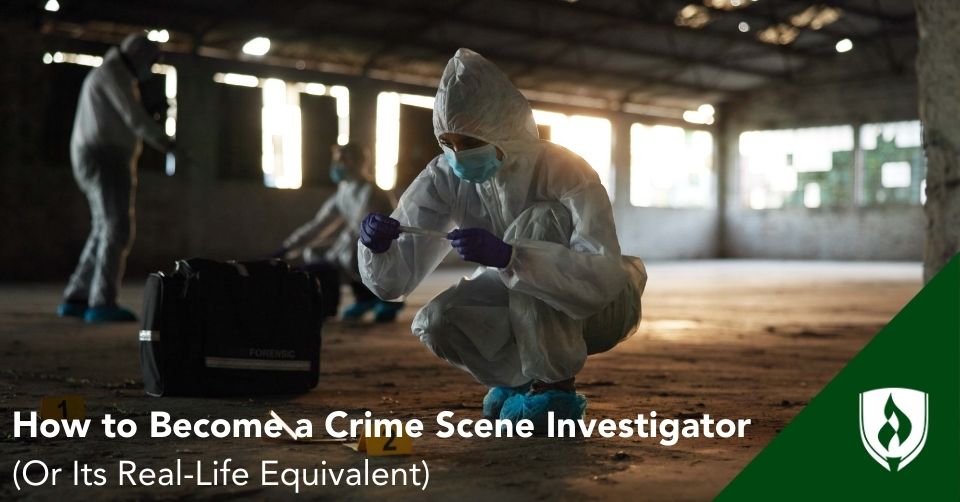
The popularity of shows like CSI and other crime shows has led millions of curious viewers searching for the term ‘crime scene investigator’ each year. Here’s a plot twist: ‘Crime Scene Investigator’ isn’t an official job title at all. It's a made-for-TV and movie invention.
Wait, what?
“Crime scene investigator is not an official career title used in law enforcement,” explains Eileen Carlin, an instructor at Rasmussen University’s Law Enforcement program. “Rather, it is a term developed by the media to glamorize several different law enforcement functions like police, detective and evidence technician jobs.”
While the job title itself is a work of fiction, the role of a crime scene investigator is very real. In the real world, those responsibilities are split among trained and educated professionals with specific roles, certifications and levels of authority.1
To understand the difference between those who process crime scenes and how they do it requires separating television drama from real-world law enforcement.
Let’s investigate how to become a crime scene investigator (or its real-life equivalent).
How the crime scene investigator job is a TV creation
On TV and in movies, crime scene investigations all begin and end the same way. A trained professional arrives at the crime scene, photographs evidence, collects DNA, runs lab tests and identifies a suspect before the day is over! If that kind of speed and accuracy feels too good to be true, that’s because it is!
It’s a familiar theme on shows like CSI and Law & Order, where complicated investigations are solved in a single episode.
According to Carlin, “Television producers simply took these jobs and created the blanket title of CSI to make it appear that such a career exists.”
One of the biggest misconceptions these actors portray is the idea that a single CSI can just walk onto a crime scene and complete all functions: take photos, gather evidence, and collect DNA, explains Carlin. “Then they bring it back to the station where state-of-the-art technology allows them to analyze it, get DNA back within an hour, and arrest the offender,” she says. “That just doesn’t happen.”
In reality, access to a crime scene is super limited and very controlled—only legitimate police officers or detectives are allowed to enter and process a scene. Every step, from securing evidence to documenting its collection, must follow strict legal procedures.
“Another misconception is that these programs often show DNA results or fingerprint matches appearing within minutes or hours,” says Carlin. “Laboratory practice can take weeks or months due to extensive backlogs and meticulous procedures. Real cases take many months, if not years, to solve because of the lag time in analyzing evidence.”
In real investigations, forensic analysis can take weeks or even months to come to a conclusion, due to laboratory backlogs and testing requirements.
“TV portrays the job as a constant stream of high-stakes, fast-paced homicides. Even in large cities like New York or Philadelphia, this is not a reality,” Carlin says. “There are robberies, burglaries, thefts and other unglamorous crimes to be investigated—not just murders.”
What really happens when a criminal act is reported
Art imitates life, but sometimes art gets it wrong. In real life, crime scene investigations begin with a 911 phone call to report a possible offense. Once that call is answered, the local police department dispatches an officer to the crime scene to investigate and determine whether there’s immediate danger to the public. If deemed necessary, the officer will request additional officers or medical assistance.
Once the crime is confirmed, the responding officers secure the area, put up crime scene tape and restrict access. By preserving the location, you also preserve physical evidence and prevent contamination that could compromise an investigation.
The officer will then start interviewing witnesses and victims, documenting what they observed. If the case is more serious, the officer will request a detective, who has additional investigative training and authority, to be dispatched to the site. They’ll then take over the investigative work, including identifying and collecting evidence, examining the surrounding area, and determining next steps in the case.
Evidence must be logged, documented and handled according to legal procedures to preserve the chain of custody. Everything that happens at the scene must be reported in painstaking detail, because it may be scrutinized later in court.
Criminal investigations often continue through additional legal steps, including case review, charging decisions, and court proceedings, a process that can take months or even years to complete.2
“The real work is much more detail-oriented,” explains Carlin. “Interviewing witnesses and victims, involving significant time on meticulous documentation such as registering evidence, massive amounts of report writing, and administrative duties.
This process is more methodical than what you may see on television, prioritizing accuracy, legality, and accountability over speed. Even though it lacks the captivating primetime storyline, this is how real investigations stand up to legal and scientific scrutiny.
Real professionals behind crime scene investigations
Now that we’ve cleared up the fantasy career of a CSI, it’s time to look at the real professionals who handle crime scene investigations and criminal investigations.
"People mistakenly believe this is an actual job title because television shows like CSI and Law & Order make the work appear glamorous,” says Carlin. “These portrayals suggest that anyone could walk onto a crime scene and gather evidence, but nothing could be further from the truth.”
In reality, access to a crime scene is strictly controlled. No one is permitted to enter or process a crime scene unless they are an authorized police officer or detective. Every role that’s involved in the investigation operates within strict legal boundaries, specialized training and specific procedures to ensure the investigation is handled by the right professionals.
Here are some of the most common jobs that really make up what’s often referred to as the “CSI field.”
Crime scene technicians and evidence technicians
“These are civilian professionals (not certified officers) who work primarily in the field, focusing on identifying, documenting (photography, sketching), and collecting physical evidence at a crime scene,” explains Carlin.
Evidence and crime scene technicians work with police officers or detectives during crime scene investigations. They are responsible for documenting and collecting evidence and preserving the chain of custody. While they play an important role at the crime scene, they do not have the authority to independently access or process it.
After evidence is collected and logged, it’s handed off to a laboratory where a forensic scientist or forensic analyst takes over. The technician keeps detailed records, follows strict protocols for handling and storing collected materials and makes sure the findings are properly documented. In some cases, they may also be asked to testify in court about how they collected and preserved the evidence and their findings.3
Forensic scientists and forensic analyst
“These specialists generally work in laboratories where they perform chemical, biological or microscopic analyses on the evidence collected by scene technicians,” says Carlin. “They specialize in areas such as DNA analysis, ballistics, toxicology and fingerprint analysis.”
Forensic science and forensic analysts support criminal justice by conducting specialized lab work, using forensic science techniques to examine physical and trace evidence.
According to the American Academy of Forensic Sciences®, forensic science is used in law to resolve disputes, enforce regulations, and ensure public safety.1 This includes interpreting scientific data reliably and objectively for use in a courtroom.
With a focus on evidence analysis rather than fieldwork, they can draw conclusions about the chemical composition and characteristics of materials like DNA, fibers and toxins. Their ability to document findings clearly and quickly is important because their results become part of the legal testimony. Sometimes they’ll be expected to explain how tests were conducted, what the results show, and how they should be interpreted by attorneys, juries and judges.
For more on what forensic science is really like, check out 6 Common Forensic Science Myths and Misconceptions You Should Know.
Police officers and detectives
“In many jurisdictions, especially smaller ones, sworn police officers or detectives receive specialized training to gather evidence at crime scenes as part of their broader investigative duties,” Carlin says.
Police officers and detectives play a starring role in criminal justice proceedings, especially in crime scene investigations. Police officers are typically the first to respond, and their role includes protecting lives and property, securing crime scenes, and interacting with victims, witnesses, and other persons involved. Detectives, who are sworn police officers, focus more on gathering facts and evidence and developing cases.4
While many of their job duties overlap, they may differ based on department size, jurisdiction and their assignment. Both police officers and detectives are required to write detailed reports, evidence logs, and investigative summaries that may be used during legal proceedings.
Police officers and detectives may have to testify in court to explain how forensic materials were collected, documented and handled. Their ability to communicate clearly and follow proper procedures helps ensure the investigations hold up under legal scrutiny.
Special investigators
“Some agencies have specialists for specific types of crimes or evidence, such as arson investigators, digital forensics specialists, or death investigators who work with the medical examiner,” says Carlin.
Special investigators take investigative work a few steps beyond routine patrol work. Unlike jobs that respond to active crime scenes, special investigators dig deeper into public complaints and questionable actions. They use their skills and knowledge to focus on specific persons or organizations to uncover information that may not be obvious to the naked eye. Their jobs include gathering, organizing and analyzing data related to legal, financial, criminal or personal activities to connect the dots in a particular case.
These professionals work in many different settings, including government agencies, private companies, or law enforcement units dedicated to fraud, regulatory compliance or internal investigations.3
Job duties may include conducting interviews, checking records and databases, performing surveillance, and writing reports and documenting findings.
Special investigators build cases that may later be referred to detectives or prosecutors and help prepare materials for court. Depending on their jurisdiction, they may also join forces with local officers to make arrests or serve warrants.
How to start a career in crime scene investigation
Students interested in the many roles associated with crime scenes should know there’s no single pathway required to enter the field. Instead, you should consider what kind of role you’d prefer in an investigation—law enforcement, forensic science, or technical support.
Forensic roles may also require specialized certification, depending on their agency’s requirements. Certification programs through organizations such as the International Association for Identification® can boost credibility and increase career opportunities.
The minimum requirements for law enforcement tracks may include completing your police academy training and meeting department standards for sworn officers. Since these roles combine investigative skills and public safety tasks, you may need several years of prior experience before becoming a detective or special investigator.
No matter which track you choose, it’s important to have excellent writing ability, strong attention to detail, and communication skills. These come in handy if you need to prepare reports or testify in court about evidence handling or your analytical findings.
Job opportunities in crime scene investigation fields
CSI-related job openings can be discovered across municipal police departments, state law enforcement agencies and forensic laboratories. Entry-level roles such as crime scene technicians, are often advertised on job listings. Advanced roles like forensic analysts or specialized investigators require formal education, advanced degrees, certifications or real-world experience.
When you understand the education, training and experience required for each of these roles, you can build a solid career plan and be in the driver’s seat of your future. This path may lead to law enforcement, forensic science, or another specialized role within crime scene investigations.
For more on that, check out How to Become a Police Officer: Your Step-by-Step Guide.
Are crime scene investigator roles right for you?
As you settle in to watch the most recent episode of Law & Order or CSI tonight, you now have the knowledge and ability to separate television drama from real-world careers. Crime scene investigator roles rely on many trained professionals, each with a specific role, qualifications and level of responsibility. Now that you know how they all work together, you can decide which path best matches your goals.
For further information about which movie and TV roles really do exist, check out our article, “What is a Criminal Investigator.”
1Federal Bureau of Investigation, A Brief Description of the Federal Criminal Justice Process, [Accessed October 2024] A Brief Description of the Federal Criminal Justice Process — FBI, https://www.fbi.gov/how-we-can-help-you/victim-services/a-brief-description-of-the-federal-criminal-justice-process
2American Academy of Forensic Sciences, What Is Forensic Science?, [Accessed October 2024] https://www.aafs.org/careers-forensic-science/what-forensic-science
3ZipRecruiter, What Is a Special Investigator?, [Accessed October 2024] https://www.ziprecruiter.com/career/Special-Investigator/What-Is-How-to-Become
4Bureau of Labor Statistics, U.S. Department of Labor, Occupational Outlook Handbook, Police and Detectives, at Police and Detectives : Occupational Outlook Handbook : U.S. Bureau of Labor Statistics, https://www.bls.gov/ooh/protective-service/police-and-detectives.htm#tab-2
5American Academy of Forensic Sciences® is a registered trademark of American Academy of Forensic Sciences
6International Association for Identification® is a registered trademark of International Association for Identification