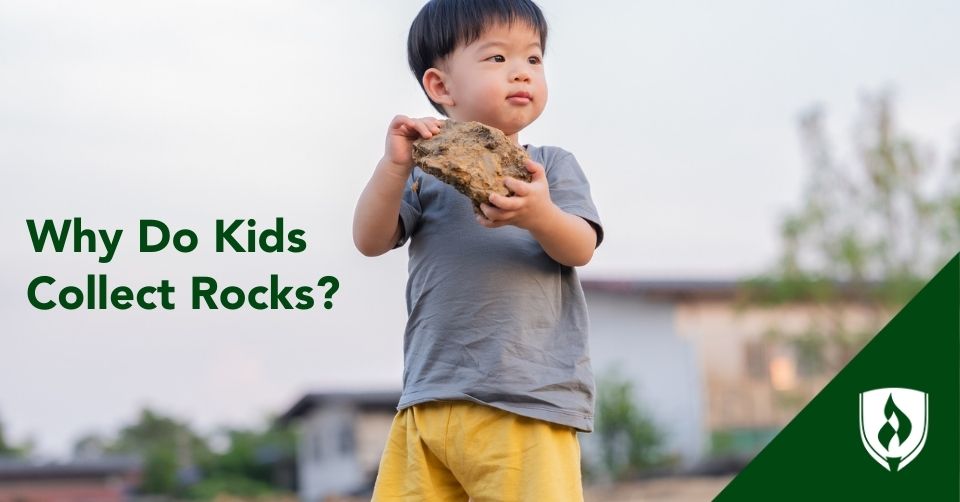
On many days, a simple walk with my 4-year-old and our dog turns into something else entirely. We leave the house with empty hands and pockets. By the time we come back, she’s carrying a tiny bouquet of treasures: smooth rocks, acorns, small flowers that barely survived the journey home.
I’m usually juggling the leash in one hand and a pocket full of “very important” pebbles in the other.
If you’re a parent, you might know this feeling. Maybe you’ve stepped on a “special rock” in the middle of the living room. Maybe you’ve pulled sticks, ticket stubs or crumpled leaves out of your child’s jacket or the washing machine. To you, it might look like clutter. To them, it’s a collection.
At some point, most of us wonder, “Why does my kid collect so many things?” Is this just a quirky habit, or does it actually mean something for their growth and development?
Turns out, there’s a lot going on beneath the surface when kids collect things—especially rocks and other little treasures they find outside. Early childhood educators, including Rasmussen Dean of Education, Dr. Mary Muhs and Assistant Professor, Joni Kuhn, see children’s collections show up in real classrooms every day.
What does it mean when kids collect rocks and random objects?
If your child has ever stopped everything to pick up “just one more” treasure, you are not alone. Many kids go through a collecting phase in early and middle childhood. For some, it’s rocks or acorns. For others, it’s bottle caps, stickers or tiny toy animals. My daughter once found a single red feather on a walk, and that was it—every walk after that became a mission to find more feathers, preferably red ones.
“When children collect things, to me it means they are developing their interests and their cognitive skills,” says Rasmussen ECE assistant professor, Joni Kuhn. She says there’s an emotional layer to the process as well.
“Collecting items also gives children a sense of control,” she adds. “This can help them feel secure.”
A child who carefully lines up erasers or keeps a special object in their desk may be using that routine to steady themselves before they join in with the rest of the day.
Pattern-finding
Treasure hunting often starts in the preschool years. At first, the collections are random: anything interesting goes into pockets or onto the kitchen counter. As kids get a little older, their collections may become more organized; think trading cards, figurines or specific types of rocks. It might look messy to adults, but there is real work happening in their brains.
“Collecting is an example of a schema,” says early childhood expert Dr. Muhs. “Which is a term for a repeated pattern of behavior that children use to investigate the world around them.”
In simple terms, a schema is a mental pattern or theme that helps children test ideas and understand how things work.
When kids collect, they’re not just grabbing junk. They’re noticing what items have in common, what makes them different and how they fit into their growing picture of the world.
Self-expression and exploration
Kids also use collections to express who they are. The child who collects feathers might be drawn to birds, colors or soft textures. The one who lines up toy cars may be interested in speed, order, or how things move. Kuhn and Muhs explain that collections can be a quiet way of saying, “This is what I like. This is part of me.”
If you’ve ever worried that your child’s collecting might be a sign of hoarding or obsessive-compulsive disorder (OCD), it may help to know that typical childhood collecting is very common and healthy.1
Most kids grow in and out of different collections over time. In most cases, that pile of treasures is a normal part of growing up.
Sorting, matching and early math skills
If you’ve ever watched a child dump out a pile of rocks or toy cars, you may notice they don’t stay in a random heap for long. Kids love to sort and group things. They line items up by size, make “families” by color or separate rough rocks from smooth ones. Even if no adult asks them to, they often start creating little systems on their own.
“When children collect things, to me it means they are developing their interests and their cognitive skills,” Kuhn says. She explains that counting and sorting by size, color, shape, and other characteristics build mathematical skills in their cognition. In other words, that little pile of treasures on the table is also a tiny math lab.
This kind of quiet sorting is actually early math in action. When your child decides which rocks go in which pile, they’re practicing:
- Comparing size, color, shape and texture
- Counting how many items are in each group
- Noticing which pile has more or less
- Putting objects in order, like “smallest to biggest”
Early math standards often highlight sorting and classifying as key skills in preschool and early elementary years. Collections give kids a natural, fun way to practice those skills without a worksheet in sight.1
These patterns are part of how children’s brains are working things out, Dr. Muhs explains. She notes that schemas are how a child’s brain organizes information, and that children collect items because they are testing ideas and building understanding. These repeated habits—lining things up, grouping, sorting—are “normal and essential” pieces of cognitive development, not just boredom or fussiness.
Observation and little “science experiments”
Collections also invite kids to look more closely at the world around them. A rock is not just “a rock” to a child who collects. It might be shiny or dull, heavy or light, smooth like glass or bumpy like a toad. Leaves, shells, feathers, and other nature items offer the same chances to notice patterns and details.
Children often turn their collections into small science experiments without anyone telling them to.1 They might:
- See which rocks can stack without falling
- Drop different items in water to see what sinks or floats
- Compare two “matching” objects and point out how they are the same and how they are different
Dr. Muhs says kids are constantly “testing ideas, making predictions and building understanding” when they explore their collections. That’s the heart of scientific thinking. They are asking simple questions, trying things out, and learning from what happens next.
To us, it might just look like a child playing with rocks in the grass. But inside their mind, they are sorting, measuring, noticing and wondering—all through the small treasures they chose themselves.
Building socio-emotional skills: comfort, control, and identity
For many kids, a collection is more than a hobby. It can also be a source of comfort. Having a special rock in their pocket or a small group of “treasures” on the nightstand can help a child feel calm and grounded.
“Collecting items also gives children a sense of control over, at the least, how a part of their day will ‘go,’” says Kuhn. “This can help them feel secure.”
In child development, you might hear the term “transitional object.” That usually means a comfort item that helps a child handle change, like a favorite blanket or stuffed animal. For some kids, a tiny rock or a feather can play a similar role.
Kuhn remembers a first grader who had about twenty pencil-top eraser characters.
“Having these erasers helped him to feel safe and lining them up was calming for him,” she says. The routine of lining them up before work was part of how he got ready to learn.
Collections also give kids a strong sense of ownership and pride. A child who says, “These are my rocks,” is not just talking about objects. They are saying, “I chose these. They matter to me.”
Dr. Mary Muhs notes that when children collect things that remind them of a person or an experience, “they are keeping those memories close to their heart.” A feather from a walk with a parent or a shell from a special trip can hold feelings and memories that are hard to put into words.
Social skills and storytelling hidden in collections
Most kids don’t just show you an object—they tell you its story. A rock isn’t only “from outside.”
It’s “the rock I found at the park,” or “the shiny one I found by the big tree at school.” Each item becomes a little bookmark for a memory.
When kids talk about their collections, they’re practicing important language skills. They describe colors, textures and shapes. They explain what happened first, what happened next, and why this particular rock or feather is special. That kind of storytelling builds both vocabulary and narrative skills like being able to tell a beginning, middle and end.
Collections can also act like social glue. A child might trade cards on the bus, line up toy cars next to a friend’s, or invite another child to see their rock collection. Finding someone who loves the same kinds of treasures can help kids feel understood, confident and included.
Why rocks, specifically, are so irresistible
Of all the things kids could collect, rocks might be the clear champion. They’re everywhere and they’re free.
You don’t have to go to a store or plan an activity, so a kid can spot a “special” rock in the driveway, at the park, or on the way into the grocery store.
Rocks are also very sensory. Some are smooth like glass, others are rough or bumpy. They can feel heavy in a small hand or light enough to toss. They come in different colors, patterns and shapes. Even tiny changes—a little sparkle, a stripe, a weird curve—can make one rock stand out from the rest.
This makes rocks perfect for all the comparing and sorting kids love to do. Dr. Muhs notes that when children collect rocks or cars, they are “naturally comparing and contrasting, valuing the uniqueness of each item even though they are all in the same overall category.”
Lining up rocks from smallest to biggest, making a “sparkly” pile and a “plain” pile, or stacking them into towers all help kids work on spatial reasoning and problem solving.
For many families, rocks also keep kids connected to the outdoors. A simple walk can turn into a slow, joyful scavenger hunt with a Fannie pack around her waist as a mobile treasure chest.
How parents can support healthy collecting
Watching your child’s collection grow can be funny, it can also be a little overwhelming when rocks and tiny toys start taking over every surface. The goal isn’t to shut down collecting, but to shape it so it works for your child and your home.
A simple first step is to get curious. Ask your child to tell you about their treasures:
- “What made you pick this rock?”
- “Where did you find this feather?”
- “Which one is your favorite, and why?”
These conversations show your child that you take their interests seriously, while also giving you a chance to guide what comes home. You can offer clear, age-appropriate limits, such as:
- “We can bring home two rocks today—let’s pick your favorites.”
- “We can’t take living things or anything that could hurt someone, but we can look at them and leave them where they belong.”
Early childhood expert Dr. Mary Muhs notes that even teachers have to set boundaries around collections. “When it starts to come to the childcare program,” she says, “establishing boundaries in partnership with their family will help.” At home, that same idea applies: you’re not the “mean” parent for having limits. You’re helping your child enjoy their collection in a way that fits real-life spaces and routines.
When collecting might be something to check on
By now, you can probably see that most childhood collecting is normal. It helps kids learn, feel safe and show who they are. For most families, a few jars of rocks or shelves of tiny toys are simply part of the growing-up years.
Still, it’s natural to wonder if there’s ever a point where collecting could be a concern. The good news is that for most children, it doesn’t come close to that line. When collecting does become a problem, it usually shows up in bigger patterns, not just one habit.
You might consider talking with your child’s pediatrician or a mental health professional if you notice things like:2
- Your child becomes extremely upset or distressed if any item is moved, cleaned, or put away
- The collection makes it hard to live daily life—for example, they can’t sleep in their bed because it’s covered in objects, or they have intense meltdowns any time you try to tidy
- Collecting is paired with other concerning behaviors, such as very high anxiety, rigid rituals that they must repeat over and over, or other signs a doctor has asked you to watch for
Even then, it’s important to remember that one behavior alone is usually not enough to diagnose anything. Clinicians look for patterns over time, across different settings (home, school, activities), before deciding what might be going on.
In many cases, simple structure is enough.
Kuhn once worked with a second grader who had an unruly pencil collection. The pencils were rolling everywhere and interrupting work, but the solution wasn’t to panic or remove them all. Instead, Kuhn added a clear system—a zipper bag that kept the pencils visible but contained—and the student relaxed.
The same can be true at home. If a collection is starting to spill into every corner, sometimes a new routine, a limit, or a special storage spot can bring things back into balance. When in doubt, you can always check in with a trusted health provider. But for most kids, their “treasures” are simply part of how they’re learning to love, explore, and understand their world.
The silliest and sweetest collections from the classroom
If your child has a growing collection at home, chances are their teacher has seen a version of it at school too. Dr. Muhs says children typically collect “rocks, or acorns, seashells or pencils.” But sometimes the collections get a little more specific—and a lot more memorable.
Mary remembers a child who collected paper clips. Not just a handful, but enough to turn into a project every day.
“He would sort them, line them up, organize them by size and connect them together into a long chain,” she recalls. “He included colorful or shaped clips but usually just the silver ones.” To an adult, it might look like a pile of office supplies. To him, it was a carefully built chain of tiny metal treasures.
Kuhn shares a similar story about a first grader and his pencil-top eraser characters. “He had about 20 pencil-top, eraser-characters,” she says. “He had to line them up perfectly on his desk, before he could concentrate on his ‘desk work.’” A para-educator who worked with him allowed those ten minutes of careful arranging every morning, because “it’s worth it for him to be able to concentrate through the morning.”
In both stories, the collections are front and center. Kids are proud to show them, line them up, and explain their systems. For teachers, these aren’t just messes to be cleaned up. They’re part of the child’s routine, a normal and often charming piece of classroom life.
What collections tell teachers about children
To educators, a collection is more than a pile of objects; it’s a window into how a child thinks and feels.
“Children collect items because they are testing ideas, making predictions, and building understanding,” Dr. Muhs says. She describes these behaviors as normal and essential parts of cognitive development.
When a child chooses one type of object over and over again—rocks, cars, feathers, erasers—it can reveal their interests and strengths. Maybe they are drawn to patterns, to the natural world, or to tiny details. As Muhs explains, if they collect rocks or cars, they are “naturally comparing and contrasting, valuing the uniqueness of each item even though they are all in the same overall category.”
That’s early problem-solving and flexible thinking in action.
Because of this, many teachers choose to work with collections instead of against them. They might fold a child’s interests into show-and-tell, use their rocks for a sorting activity, or set aside a safe place in the room where a few special items can be displayed.
Educators might allow a child ten minutes of careful arranging if they know it will help the student focus for the day.
At home and at school, that same mindset can make a big difference: rather than seeing collections as clutter, adults can see them as clues about who a child is becoming.
Seeing your child’s collection through a new lens
The next time you’re emptying tiny rocks, feathers, or mystery crumbs out of your child’s pockets, you might pause for a second. Yes, it can feel like clutter. Yes, it ends up on your counters, in your car, and sometimes in the washing machine. But underneath all of that, something important is happening.
Collecting helps kids learn. When they sort and group their treasures, they’re building early math and science skills. It helps them organize their world, as their brain creates patterns— schemas—to make sense of what they see and feel.
Like so many things in early childhood education, when you understand the important developmental work going on in a child’s brain, you can make room for what they are doing, and offer better support. This is one of the reasons people decide to study child development--it really changes how you interpret children's behavior.
Those little treasures may not look like much, but to your child, they’re pieces of a bigger story they’re still learning how to tell.
These early years of their lives will shape their experiences forever. It’s worth taking the time to understand all the connections and changes they experience from ages 1-5, and it’s worth giving the professionals who nurture these stages of life and learning all the respect and support they deserve.
Check out 5 Reasons the Importance of Early Childhood Education Is Impossible to Ignore.
This blog is for general informational purposes only and does not constitute physical or mental health advice. Please consult with professionals in the healthcare industry regarding your concerns or questions.
1Alex Orrmalm &Marek Tesar, Imagining tiny archives: exploring young children’s collecting of nature things. Dec 30, 2024, https://www.tandfonline.com/doi/citedby/10.1080/23257962.2024.2371454