What Is Organizational Leadership?
03/19/2026
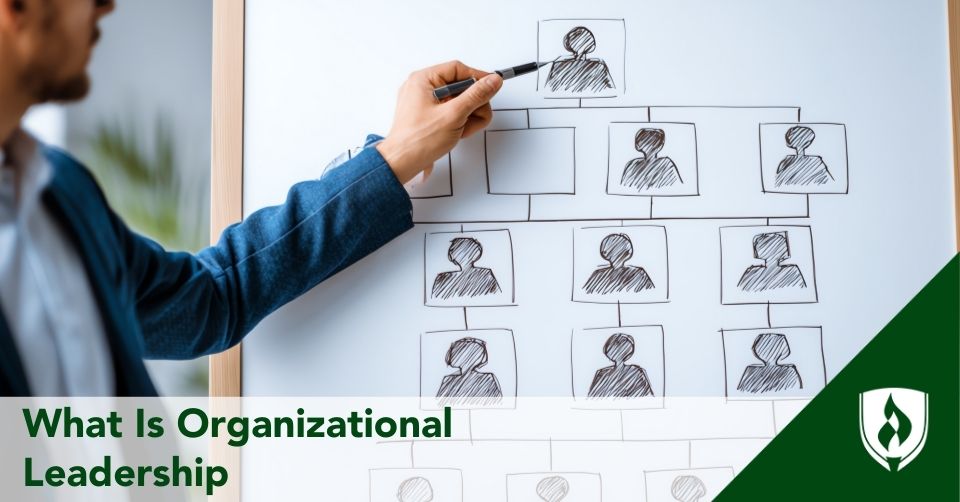
If you’ve ever wondered what is organizational leadership, it’s generally those who set the direction for an educational institution, a corporation, a nonprofit, or a fast-growing startup and how they inspire others to move toward that vision.¹
If you're exploring degree options, researching leadership roles, or simply curious about how organizations succeed, understanding organizational leadership is an important first step. Explore what it means, how it differs from management, and the role it plays in how an organization operates from day-to-day activities to long-term strategy.
Defining Organizational Leadership
At its core, organizational leadership is the practice of guiding teams and managing people within an organization to achieve shared organizational goals and fulfill the organization’s mission.
Unlike approaches that focus only on individual performance, organizational leadership looks at the bigger picture:¹
- Establishing a clear vision
- Setting strategic goals and decision-making
- Shaping culture and values
- Supporting talent development
- Leading change
- Strengthening ethical decision making
Organizational leaders align people, processes, and strategies so the organization can move forward with purpose. They focus not only on achieving goals, but also on how team members grow, contribute, and develop along the way.¹
Organizational Leadership vs. Management
People often use leadership and management interchangeably, but they are not the same. Both may provide a strong foundation, but they focus on different skills and serve different functions.²
Management Focuses on Structure and Execution
A traditional management approach centers on maintaining systems and daily operations. Management typically involves:²
- Overseeing and planning processes, policies, and procedures
- Accounting, financial planning, marketing and operations
- Monitoring performance metrics
- Ensuring teams successfully carry out assigned tasks
Management may help employees understand how their work contributes to the organization’s goals.
Organizational Leadership Focuses on Vision and Direction
Organizational leadership goes beyond operations. It emphasizes guiding teams toward long-term success. Organizational leaders may:²
- Set strategic goals aligned with the organization’s mission
- Inspire change and innovation
- Motivate people by recognizing their unique talents
- Communicate effectively across teams
- Build engaged employees through trust and purpose
While management keeps the organization functioning, organizational leadership shapes where it is headed. It blends strategic thinking, emotional intelligence, and communication skills.²
Both leadership and management are important. However, strong organizational leadership skills are especially critical when navigating change, driving innovation, and helping teams work toward their goals.²
Why Organizational Leadership Is Important
Organizational leadership plays a critical role in shaping both the success of an organization and the wellbeing of its employees. Research shows that high-quality leadership is associated with improved organizational performance and may contribute to teams and projects working more efficiently. At the same time, strong leadership positively affects employee satisfaction and reduces workplace stress, creating a healthier, more motivated workforce.³
Effective leadership is more than a managerial function. It can be a key driver of measurable outcomes. Leaders who cultivate clear direction, support, and engagement within their teams may enhance productivity but may also foster an environment where employees can feel valued and empowered. By aligning organizational objectives with employee needs and capabilities, strong leadership may benefit both people and organizations.³
Common Components of Organizational Leadership
According to the Society for Human Resource Management® (SHRM®), the core components of organizational leadership encompass the key behaviors, skills, and practices that shape how leaders guide teams and influence organizational outcomes.⁴
1. Leadership as Influence
Leadership is typically a process of determining direction, influencing a group, and guiding it toward a specific goal. In addition to managing tasks, they can inspire, guide and unite people around a shared vision or organizational mission.⁴
2. Empowerment and Coaching
Leaders may empower others to make decisions that support organizational goals, offer coaching and support, and foster responsibility among team members.⁴
3. Learnable Leadership Behaviors
While some people may have leadership tendencies, many leadership competencies like strategic thinking and communication can be learned and cultivated.⁴
4. Key Leadership Traits and Competencies
According to SHRM, strong organizational leaders may display a set of core traits and competencies, that may include:⁴
- Integrity and ethical conduct
- Strategic thinking
- Problem-solving
- Communication and relationship building
- Innovation and adaptability
5. Emotional Intelligence and Adaptability
Self-awareness, interpersonal effectiveness and the ability to adapt leadership behaviors to different organizational contexts are all critical components of organizational leadership.⁴
6. Development Practices That Support Leadership
Some other organizational practices that may help build leadership over time may include:⁴
- Mentoring and coaching programs
- 360-degree feedback
- Group-based development
- Stretch assignments that can challenge leaders to grow
What Can You Do With a Degree in Human Resources and Organizational Leadership?
If you’re exploring higher education options, you may be wondering what career paths this degree may support.
Graduates may pursue positions such as:⁵
- Human resources manager
- Compensation and benefits manager
- Training and development manager
- Personnel recruiter
- Training and development specialist
- Benefits coordinator
- Compensation and benefits analyst
- Human resource generalist
- Human resource director
Because organizational leadership skills are transferable, they typically apply across industries including business, education, healthcare, and nonprofit sectors.
Career paths vary based on factors such as prior experience, geographic location, and individual qualifications.
How To Determine if Organizational Leadership May Be a Fit For You
To determine if organizational leadership may be a fit for you, start by evaluating your personal strengths and career goals. Consider the following questions:²
- Do I enjoy motivating individuals and guiding teams?
- Do I want to lead rather than simply follow?
- Do I value soft skills like communication and emotional intelligence?
- Do I aspire to leadership roles or future leadership positions?
- Am I interested in personal growth and professional development?
You don’t need to be a CEO to benefit from leadership education. In fact, organizations depend on effective leaders at every level, from team leads to senior executives.
Building the Foundation for Future Leadership
Organizational leadership involves guiding teams, setting strategic direction, and supporting individuals in achieving meaningful goals. Beyond formal authority, it emphasizes influence, vision, and fostering the growth of others.¹
Understanding organizational leadership highlights the key skills and practices that shape how teams and organizations operate.
Society for Human Resource Management® is a registered trademark of Society for Human Resource Management 1800 Duke Street, Alexandria, Virginia, United States, 22314.
SHRM® is a registered trademark of Society for Human Resource Management 1800 Duke Street, Alexandria, Virginia, United States, 22314.
¹Zaccaro, S., & Klimoski, R. (2001). The Nature of Organizational Leadership An Introduction. The Nature of Organizational Leadership, at https://www.researchgate.net/publication/242546000_The_Nature_of_Organizational_Leadership_An_Introduction (accessed Feb.24, 2026).
²Rasmussen University, Organizational Leadership vs Business Management: Choosing Your Path, at https://www.rasmussen.edu/degrees/business/blog/organizational-leadership-vs-business-management/ (accessed Feb. 24, 2026).
³Haile, G.A. (2023) Organizational leadership: How much does it matter? British Journal of Industrial Relations, 61, 653–673. https://doi.org/10.1111/bjir.12711 (accessed Feb. 24, 2026).
⁴The Society for Human Resource Management, Toolkit: Developing Organizational Leaders, at https://www.shrm.org/topics-tools/tools/toolkits/organizational-leadership-development (accessed Feb.24, 2026).
⁵Rasmussen University, Human Resources and Organizational Leadership - Flexible Degree, at https://www.rasmussen.edu/degrees/business/hr-organizational-leadership/ (accessed Feb. 24, 2026).